


The pupil of the spectrograph is an image of the primary
mirror formed by the secondary and the collimator.
The pupil diameter  is simply set by the expansion
of the beam as it reaches the collimator, as shown in
Figure 2, and its location is set by
the focal length of the collimator.
is simply set by the expansion
of the beam as it reaches the collimator, as shown in
Figure 2, and its location is set by
the focal length of the collimator.
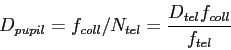
gives the minimum size of a dispersing element in the
collimated beam. This is a critical number since it sets the
minimum size of a grating, grism, or other optical device that the
instrument requires.
Off-axis beams, which are displaced by
 in the focal plane, pass through the pupil at an angle
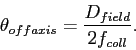
All the light from on- and off-axis beams passes through a ``waist'' at the pupil. If we introduced a screen into the light path at the pupil, we would see an in-focus donut-shaped image of the primary mirror. If the screen were placed ahead of or behind the pupil, the image of the primary would be not clearly focused.
The pupil size interacts with the field of view indirectly.
Once the collimator focal length  is chosen, increasing the
field of view does not increase the pupil size, since all
the off-axis beams pass through the ``waist'' of the pupil.
However, if we choose a
long , then off-axis light enters the collimator at
a less extreme angle, so the collimator lens is slower and
easier to design. But long requires a larger
pupil. Equivalently, from the equations from
is chosen, increasing the
field of view does not increase the pupil size, since all
the off-axis beams pass through the ``waist'' of the pupil.
However, if we choose a
long , then off-axis light enters the collimator at
a less extreme angle, so the collimator lens is slower and
easier to design. But long requires a larger
pupil. Equivalently, from the equations from  above,
we see that increasing relative to
above,
we see that increasing relative to  makes
the collimator slower. So although field of view does not
depend directly on pupil size, in real optical designs
it is difficult to
image a large field through a small pupil.
makes
the collimator slower. So although field of view does not
depend directly on pupil size, in real optical designs
it is difficult to
image a large field through a small pupil.